


Recovery and Utilisation of Waste Heat: publication of seven project factsheets
Accessible, quick to implement and cost-effective, waste heat recovery enables industrial sites to immediately reduce their fossil fuel consumption and CO₂ emissions, whilst boosting their competitiveness. However, each site has its own specific potential, and solutions must be tailored to the site and its technical, economic and organisational constraints.
It is with this aim of providing practical support to manufacturers that the ALLICE Alliance is today publishing a report featuring seven case studies illustrating a variety of long-standing projects, highlighting the robustness of these solutions that have been tried and tested in the field.
In particular, the case studies highlight the longevity of the installations, with operating lifespans ranging from 2 to 10 years.
Testimonials from industry representatives on waste heat
Manufacturers and solution providers come together to share details of their collaborations and feedback on specific projects involving the recovery and utilisation of waste heat from a range of sectors.
Some of these projects had, in fact, been presented at our biennial ALLICE Congress and at FIRE (an event dedicated to waste heat).
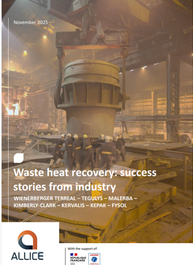
Each fact sheet includes:
- the scope of the project and the process involved,
- the decision-making criteria that guided the choice of solution,
- the progress of the project (timeline, funding),
- as well as the results achieved in terms of energy savings.
In particular, find out what these people have to say:
- Terreal and Dalkia, on utilising intermittent heat from a kiln to power a tile dryer;
- Tégulys and Ecotechceram, focusing on the recovery of drying vapour with thermal enhancement using a heat pump;
- Malerba and JMOOS, on heat recovery from a surface treatment oven (paint curing);
- Kimberly-Clark, with the recovery of vapours from the paper drying process;
- Kervalis and Terrao, and heat recovery from fouled vapour lines at an animal products manufacturing site;
- Kepak and Thermal Energy International, on the recovery of heat from fouled steam lines at a slaughterhouse;
- Fysol and Coretec, for heat recovery from a glass furnace to supply drying lines.
Detailed project
sheets covering all aspects of a waste heat recovery project.
These case studies confirm one thing: waste heat represents a largely untapped energy source, capable of delivering immediate benefits to manufacturers. Whether the aim is to reduce costs or improve environmental performance, these projects demonstrate that solutions exist, are well-established and already in operation.
By sharing these concrete achievements, the ALLICE Alliance hopes to inspire and guide other manufacturers towards similar initiatives, so that together we can accelerate the transition to a low-carbon economy.